
Share the page
How – and how far – can we still adapt? Knowledge and societies responding to the challenges of adaptation
Published on

-
When
-
From Tuesday October 6, 2026 to Wednesday October 7, 2026
-
Schedule
-
9:00 AM – 6:30 PM CET
-
Where
-
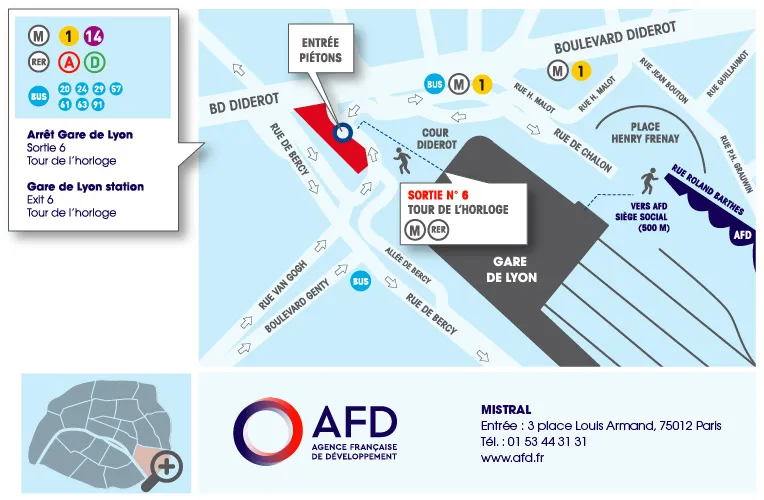
Mistral Auditorium – 3, place Louis Armand PARIS 75012, France
In-person event with live streaming
Join us for the 17th AFD International Research Conference on Development.
Registration
Organized by AFD Group as part of the French Presidency of the G7, this high-level international conference will bring together researchers, public decision-makers, development practitioners, and civil society actors to address the challenges of climate change adaptation.
The conference will bring together a wide range of leading researchers, including several authors of and contributors to the work of the Intergovernmental Panel on Climate Change (IPCC), alongside public policymakers, development practitioners and representatives of international institutions.
As climate impacts intensify, how can we design adaptation strategies that are fairer, more effective and better rooted in local realities? How can we connect research, public policy, and field experience to accelerate the implementation of concrete responses?
Over two days, discussions will focus in particular on: cities facing the challenges of adaptation; Locally Led Adaptation (LLA); measuring the progress of adaptation; the limits of adaptation; envisioning adaptation; new frontiers in adaptation; and the adaptation as a macro-fiscal challenge.
Each session will bring together research findings, lessons from the field and public policy perspectives to better understand how knowledge on adaptation can be translated into concrete decisions, practices, and forms of cooperation.
The sessions will also foster dialogue between experiences from AFD's partner countries, international research, and the challenges faced in France and elsewhere in Europe, encouraging cross-learning between territories experiencing the impacts of climate change.
At a time when climate impacts are intensifying, this conference aims to contribute to the renewal of the knowledge, practices, and forms of cooperation needed to strengthen societies' capacity to adapt.
Watch the live stream (coming soon)
Coming soon.
Agenda and speakers
See the program for Day 1.
Welcome and introduction.
Opening discussion to frame the conference and its main challenges.
Speakers:
- François Gemenne, Professor at HEC Paris & FNRS Researcher at the University of Liège (Belgium)
- Debra Roberts, Professor at the University of Twente (Netherlands), Chair of the Scientific Committee of the AXA Research Fund, and Chair of the Board of the Red Cross Red Crescent Climate Centre
- Laurence Tubiana, CEO of the European Climate Foundation
- Benoit Faraco, Ambassador for Climate Negotiations, Decarbonized Energy and Climate Risk Prevention, Ministry for Europe and Foreign Affairs
Moderator:
- Thomas Melonio, Chief Economist, AFD
With more than two thirds of the world's population set to live in cities by 2050, and ahead of the IPCC Special Report on Cities (SR Cities, 2027), this session examines urban adaptation in the face of intensifying and increasingly interconnected risks. It pays particular attention to informal settlements, which could be home to as many as three billion people, and explores the persistent gap between planning and implementation, as well as the risks of maladaptation and green gentrification.
Speakers:
- Anna Taylor, Senior Research Officer, African Climate and Development Initiative, University of Cape Town (South Africa)
- Chandni Singh, Associate Professor, School of Environment and Sustainability, Indian Institute for Human Settlements (India)
- Vivian Dépoues, Research Lead – Adaptation to Climate Change, I4CE (France)
- Helen Davies, Director of Risk and Resilience, City of Cape Town
- Pauline Lavaud, Director of Climate and Ecological Transition, City of Paris
- Marcus Mayr, Climate Investment Principal, Urban Development, GCF
Moderator:
- Alix Françoise, Task Team Leader, FFEM
Lunch break for in-person participants; live stream resumes at 1:00 PM.
A special surprise awaits attendees on the day.
The concept of Locally Led Adaptation (LLA) is receiving growing attention as a key approach to addressing climate change. Built around eight guiding principles, LLA seeks to foster more inclusive and sustainable solutions. Climate finance actors have complementary roles to play in supporting and scaling up this agenda, with greater synergies still needed. This session examines LLA’s practical contribution and identifies the conditions required for its implementation to be truly transformative.
Speakers:
- Carina Bachofen, Director of research and strategic impact, IIED, (UK)
- Edmond Totin, Senior Lecturer in Agricultural Socio-Anthropology, National University of Agriculture (Benin)
- Janne Parviainen, Researcher, Stockholm Environment Institute (Sweden)
- Guillaume Quelin, Head of the Climate and Development Commission, Coordination Sud (France)
- Audrey Rojkoff, Head of Climate and Nature Division, AFD (France)
Coffee break for in-person participants. Live stream resumes at 3:45 PM.
This session addresses the methodological and political challenges of assessing adaptation, brought into sharp focus by the adoption of the 59 Belém indicators at COP30. While these metrics are intended to help track the Global Goal on Adaptation under the Paris Agreement, their operationalization raises questions, notably the risk of favoring what is measurable at the expense of deeper transformations. The session therefore also explores qualitative methods capable of capturing essential dimensions of adaptation that aggregate indicators struggle to take into account.
Speakers:
- Virginie Duvat, Professor of coastal geography at La Rochelle University & Senior Member at the French University Institute (France) & Invited researcher at Cawthron Institute (New Zealand)
- Timo Leiter, Distinguished Policy Fellow, LSE (UK)
- Emilie Beauchamp, Lead for Adaptation Monitoring, Evaluation and Learning, IISD (Canada)
- Madeleine Diouf Sarr, Climate Director, Ministry of Environment and Ecological Transition (Senegal)
- Lina Yassin, Climate Policy Researcher, IIED (UK)
- Gonéri Le Cozannet, Member of the French High Council for Climate & Researcher, BRGM (France)
Closing remarks and preview of the second day's program.
Speaker:
- Carl Bernadac, Director of the Economic Diagnostic and Public Policy Department (ECO), AFD
- Marie Bjornson-Langen, Deputy Executive Director - Global SDG, AFD
See the program for Day 2.
Opening address to set out the day's key challenges.
Speaker:
- Youssef Nassef, Director of the Adaptation program, UNFCCC
Isn’t the greatest challenge researchers and practitioners have faced over the past 30 years, in fact, the difficulty of imagining resilient, inclusive and desirable futures together with all stakeholders? Visions of adaptation are diverse, yet dominant narratives remain largely technocratic and top-down, often reinforcing existing power structures. Making these visions explicit allows them to be debated and reoriented; broadening the range of possible futures also broadens the range of solutions and helps reduce the risk of maladaptation.
Speakers:
- Marta Olazabal, Professor at BC3 & Principal investigator of the IMAGINE Adaptation project (Spain)
- Aurélie Ceinos, Senior Policy Adviser, Resilience Programme, IISD (Canada)
- Charlotte Da Cunha, Director of CEARC (UVSQ)
As climate risks intensify, the question of the limits of adaptation has emerged as a major scientific and political issue, with successive institutional milestones culminating in the Fund for responding to Loss and Damage (FRLD). Insurance mechanisms are useful tools but have real limitations. In the most exposed territories, the question is no longer only how to adapt, but under what conditions and for how long a territory remains livable, as well as who decides this, on what basis, and with what alternatives.
Speakers:
- Lisa Schipper, Professor of Development Geography, University of Bonn (Germany)
- Alpha Kaloga, Regional Adviser for Africa, Green Climate Fund (GCF) & Chief Negotiator for the Africa Group on Loss and Damage (Guinea)
- François Gemenne, Professor at HEC Paris & FNRS Researcher at the University of Liège (Belgium)
- Neil Adger, Professor of Human Geography, University of Exeter (UK)
- Tran Thanh Nga, Head, Adaptation Division, Department of Climate change, Ministry of Agriculture and Environment (Vietnam)
- Karina WHALLEY, Head of Public Sector, AXA Climate
Lunch break for in-person participants. Live stream resumes at 1:30 PM.
As highlighted in the IPCC’s Sixth Assessment Report, incremental adjustments are no longer enough. The challenge now is to combine them with transformational adaptation, involving systemic changes across territories and societies, while also developing a more nuanced understanding of transboundary risks. There is also a need for new methodologies that better connect past, present and long-term future timescales in order to define more robust adaptation pathways.
Speakers:
- Alexandre Magnan, Geographer, Cawthron Institute (New Zealand)
- Katy Harris, Senior Policy Researcher, SEI (Sweden)
- Adèle Tanguy, Researcher, Climate Programme, IDDRI (France)
- Saskia Werners, Senior Researcher Adaptive Water Management, Wageningen University & Research (Netherlands)
- Abu Sadat Moniruzzaman, Program Head, BRAC (Bangladesh)
Moderator:
- Christophe Buffet, Research Officer, AFD
Long carried out exclusively by environment ministries and sectoral ministries, adaptation is now becoming a factor in finance ministries' decision-making. The economic literature has grown but remains fragmented: it underestimates extreme and cascading damages, poorly captures deep uncertainty, and neglects long-term fiscal effects. Several public policy instruments are emerging to equip ministries — taxonomies, green budgeting, expenditure tagging — and public development banks have a supporting role to play.
Speakers:
- Antoine Godin, Senior Economist, AFD
- Paul Watkiss, Director, Paul Watkiss Associates (UK)
- Stéphane Hallegatte, Chief Economist for Climate Change, World Bank
- Stella Rusine Nteziryayo, Chief Executive Officer, Development Bank of Rwanda
- Benjamin Delozier, Head of the Ecological and Sectoral Policies Department, Directorate General of the Treasury, Ministry of Economy, Finance and Industrial and Digital Sovereignty (France)
- Shartsi Musherure Kuteesa, Minister of State for Finance, Planning and Economic Development (Uganda)
Moderator:
- Julie Rozenberg, Chief Economist, World Resources Institute
Political issues related to adaptation.
Speaker:
- Stella Rusine Nteziryayo, Chief Executive Officer, Development Bank of Rwanda
- Shartsi Musherure Kuteesa, Minister of State for Finance, Planning and Economic Development (Uganda)
Moderator:
- Thomas Melonio, Chief Economist, AFD
Resources
Explore below a selection of resources to go further on the topics discussed during the conference.
Research publications
- Does Climate Change Vulnerability Matter for the Allocation of Adaptation Finance? An Empirical Analysis of Donors and Instruments over the Period 2019–2023, Research Papers N°402, Editions AFD (2026)
- Human Rights and Climate Policies – The Human Rights Impacts of Climate Change and Mitigating Measures, Research Papers, Editions AFD (2026)
- Linking Weather Forecasts and Risk Financing, A Question of Development N°48, study funded by AdaptAction, Editions AFD
Institutional publications
- Aligning Climate, Nature and Development: A Crosscutting Ambition for the Planet 2025-2030 – Summary, Strategic documents, AFD Group
- Climate - Nature: Activity report 2025, Financial Statements and Activity Reports, AFD Group(2026)
- AFD & KfW Activities in the Context of Loss and Damage - Position Paper, joint AFD-KfW position paper (2023)
AdaptAction programme resources
- Adapt'Action capitalization fact sheets
- Mobilizing Knowledge on Gender, Equity, and Justice in Climate Change Adaptation
Scientific literature and partner publications
- "Status of global coastal adaptation," Magnan, A.K., Bell, R., Duvat, V.K.E. and al., Nature Climate Change, 13 (2023)
- "The value of structured expert judgment to help assess climate adaptation," Magnan, A.K., Li, J., Tanguy, A., Hallegatte, S., Buffet, C.,Climate Risk Management, vol. 47 (2025)
- "Integrating Nature-based Solutions for urban water security in global South,"Abera et al., PLOS Water, 4(10) (2025)
- "Effects of heat stress and green cover on urban birds in the megacity of Bengaluru,"Jambhekar et al., Ecological Applications, 3(35) (2025)
- "Strengthen climate adaptation research globally," Science (2022)
- "Fostering complementarity: how development and climate financiers can scale up locally led adaptation," Browne, K., El-Horr, J., Parviainen, J., Tenzing, J., SEI (Stockholm, June 2025)
- Gap Track – Global Adaptation Progress Tracker, Iddri